Home as belonging rather than property
The Salt PathHome as belonging rather than property is a central tension in Ray and Moth’s journey: they lose the house and land they had built their life around, yet discover that home is not reducible to possession. The idea is tested against repossession, housing rules, temporary shelters, and the changing meanings of the coast and countryside. A strip of path can become a home, but that discovery does not erase the material need for a secure place to live.
The house lost, and what it held
The loss begins with more than a building. After their savings were consumed by legal fees, Ray and Moth represented themselves in court; their case did not qualify for legal aid because it was classed as too complex. A charge was registered against the farm as security for Cooper’s claim, followed by a claim for possession of their home. The threatened property included the house and land, but also the accumulated particulars of family life: stones they had placed, a tree where the children played, a wall where blue tits nested, and a loose piece of lead beneath which bats lived. The home was at once a legal asset and a lived world, and the legal process could seize the former while exposing how much of the latter could not be replaced.
Ray recalls the decades invested in that place: an earlier Victorian house restored after work, the sale of it to fund the farm, and years spent reroofing a barn and digging drainage ditches while their children went to the beach with other families. Their former home represented effort, memory, safety, and the confidence of knowing where they would sleep in the years ahead. Losing it meant losing both an address and the structure around which they had organized their shared life. The distinction matters: attachment to a home is not simply a claim of ownership, even when property is the means by which that attachment has been built.
Housing choices narrowed by institutions
After the repossession, the alternatives to the tent were limited by cost and eligibility. A campsite wanted eighty pounds a week, beyond what Ray and Moth could afford, and housing benefit did not cover campsite fees. No acquaintance could offer a room or garden for more than a few weeks, while caravans in the holiday area were booked for midsummer visitors. Renting was also difficult: their credit rating had collapsed, and the council considered them low priority. The accommodation then available through the council was a bed-and-breakfast room in a place mainly used by people with drug and alcohol problems. A council employee challenged the seriousness of Moth’s illness because he might not die within a year. Ray and Moth concluded that they would rather live in their tent than accept that option.
The barriers followed them beyond that first decision. At Polly’s farm, a disused meat-packing shed offered a roof, but not an uncomplicated home. Rain struck its corrugated roof as they erected their tent on the floor; the building still felt like a processing room, with moss at the windows, insulation hanging from open rafters, and a wood burner that had melted the plastic wall covering. Polly asked for help improving the building and working on the farm instead of rent, making shelter part of an exchange of labor and friendship. It could work for a time, but when Moth was accepted to university, the prospect of leaving a roof for the uncertainty of homelessness again felt unnatural. Even the security of the shed remained conditional on circumstances and on whether they could make a new life there.
Their attempts to find work and rent elsewhere showed how those conditions accumulated. In the rural area around the farm, Ray found no job that paid more than the cost of getting to it. Her years of practical work—as a farmer, builder, plumber, electrician, gardener, and in other roles—were difficult to demonstrate without formal papers or an employer. Without secure income, independent housing remained out of reach. Moth’s student loan offered a possible fixed income for the two of them, and their credit history did not prevent them from receiving it; at the same time, his pain and deterioration made the plan uncertain. The narrative presents housing security not as a matter of choosing a different address, but as an outcome shaped by credit, income, health, available accommodation, and the terms on which help is offered.
Tent, path, and temporary belonging
The tent is both a practical refuge and a refusal of the few alternatives available to them. It gives Ray and Moth a place to settle their thoughts when the offered forms of accommodation seem unaffordable, unavailable, or intolerable. Yet shelter alone does not make a stable home: at the shed, the tent is erected indoors for familiarity, while their packs sit in a corner of a building that still feels alien. The contrast distinguishes having a roof from feeling at home without denying the importance of the roof.
On Gribbin Head, the couple lie in their tent on wet grass beneath the stars, near an estate associated with wealth and a grand domestic history. They have lost almost everything, retaining their children and each other, while the sea’s rhythm and the ground beneath them offer a different, sharply limited form of sustenance. The scene does not claim that landscape can replace housing or possessions. Instead, it holds two facts together: their insecurity is real, and a moment of connection to place can still matter within it.
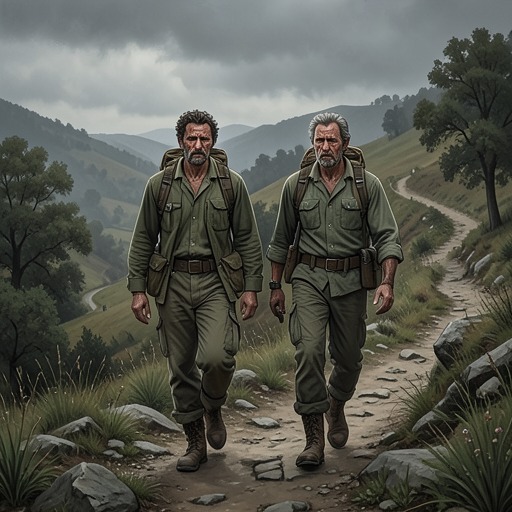
When Ray reaches Lizard Point, she recognizes that she will not return to the farm. The familiar house, slate floor, cats, garden, and view of the Plough over the mountains belong to a life no longer available. At first, the country appears as an empty space in which they have no place. Then the meaning of home begins to shift: the path, sometimes no more than a foot wide, moves her forward and becomes a strip of ground on which she can live. As she stops fighting the loss and becomes more receptive to the wind, rain, sea, and earth, belonging no longer depends on owning a patch of land. This acceptance is a change in her relation to the world, not a claim that the material deprivation has ended.
Return, memory, and the meaning of home
The return to the coast after months inland makes this altered relation bodily and immediate. At Old Harry Rocks, the sea and horizon bring relief after confinement in a place that did not hold the couple. Ray recognizes the familiar pull of the path; camping on Ballard Down, they watch the lights of Swanage across the water. The coast is not simply picturesque scenery. It offers continuity of movement and an open horizon at a time when their future remains uncertain. Ray’s later memories of the baked path, salt-laden rain, gulls, woodland, and headlands show that life outdoors has become another attachment she fears losing. The room at the farm interrupts those memories with the knowledge that Moth is slowly dying and that she may have to live without him. A sense of belonging to landscape coexists with anticipatory grief and the longing for domestic security.
The story also widens the idea of homelessness beyond the image of a person sleeping in a doorway. Its 2013 figures distinguish 280,000 UK households that said they were homeless or at risk from the 52,000 accepted as statutorily homeless; many of the remaining households received local-authority help through a relief route. Counts of rough sleeping diverge as well: the government’s one-night snapshot recorded 2,414 people across England, while the Homelessness and Information Network, funded by the Greater London Authority, counted 6,508 people sleeping rough in London during 2013, compared with a government snapshot figure of 543 there. These differing measures make visible how official definitions and counting methods can leave much housing insecurity out of view. Ray and Moth’s tents and temporary arrangements belong to a wider range of precarious situations that cannot be captured by a single stereotype.
The possibility of a different kind of home appears when Anna offers the couple her flat in Polruan as her tenants are due to move out. The coastal path passes its front door, connecting the prospect of a rented home to the route that has sustained Ray and Moth. At the point recorded, the offer is an opening rather than a completed resolution. Its significance lies in bringing together what the journey has kept distinct: a home can be a place of shelter and continuity without being owned, while belonging can also grow beyond property—in companionship, memory, and a landscape that makes forward movement possible.